
Complete Cost Breakdown: Building a Turnkey Food Production Line in 2025
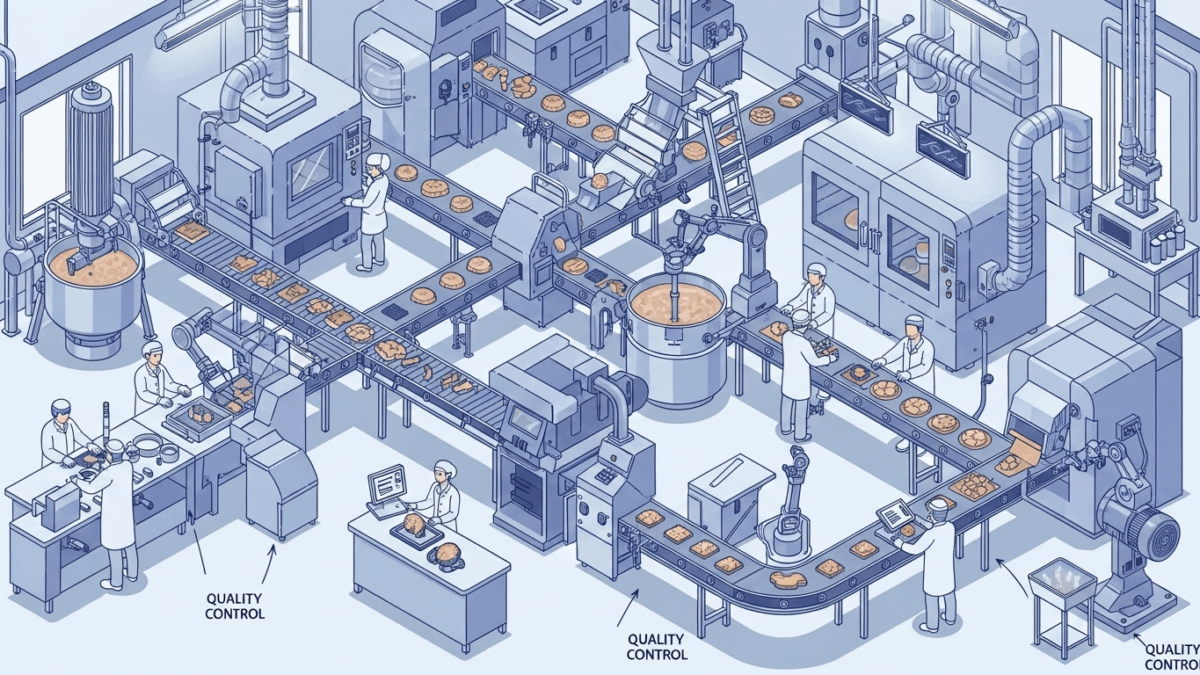
Complete Guide to Turnkey Food Production Line Setup 2025
Starting a new food manufacturing facility or upgrading your existing operation? A properly planned turnkey food production line setup can mean the difference between profitable operations and costly mistakes. This comprehensive guide walks you through every step of the process, from initial feasibility studies to final commissioning.
Table of Contents
What is a Turnkey Food Production Line?
A turnkey food production line setup refers to a complete, ready-to-operate manufacturing solution where a single provider handles every aspect of your production facility—from initial design to final commissioning. The term “turnkey” means you simply “turn the key” and start production.
What’s Included in Turnkey Solutions:
- ✅ Feasibility studies and capacity planning
- ✅ Factory layout and engineering design
- ✅ Equipment sourcing and procurement
- ✅ Installation and integration
- ✅ Staff training and documentation
- ✅ Testing, commissioning, and certification
- ✅ After-sales support and maintenance
Unlike piecemeal approaches where you coordinate multiple vendors, a turnkey food production line setup provides a single point of accountability, reducing risks and ensuring seamless integration.
Why Choose Turnkey Solutions Over Traditional Setup?
1. Reduced Project Complexity
Managing multiple equipment suppliers, contractors, and engineers is time-consuming and risky. A turnkey food production line setup simplifies this by consolidating all responsibilities under one experienced provider.
2. Faster Time to Market
With streamlined coordination and proven processes, turnkey solutions typically reduce setup time by 30-40% compared to traditional methods. Your production line becomes operational months earlier, generating revenue sooner.
3. Guaranteed Compatibility
All equipment in a turnkey food production line setup is selected and integrated to work together seamlessly. No compatibility issues, no finger-pointing between vendors, no production bottlenecks.
4. Cost Predictability
Fixed-price turnkey contracts eliminate budget surprises. You know your total investment upfront, making financial planning and ROI calculations more accurate.
5. Lower Risk
With one provider responsible for the entire turnkey food production line setup, you transfer technical and operational risks to experienced specialists who guarantee results.
6. Compliance Assurance
Turnkey providers ensure your production line meets all food safety regulations (HACCP, ISO 22000), building codes, and industry standards from day one.
The 6-Phase Turnkey Food Production Line Setup Process

Phase 1: Feasibility & Planning (2-4 Weeks)
The foundation of successful turnkey food production line setup begins with thorough planning:
Key Activities:
- Product definition: Specify what you’re manufacturing, target capacity, and quality standards
- Market analysis: Validate demand and distribution channels
- Site evaluation: Assess location for utilities, logistics, and compliance
- Capacity planning: Determine optimal production volume based on market demand
- Preliminary budgeting: Establish realistic investment expectations
- ROI modeling: Project payback periods and profitability timelines
Deliverables: Feasibility report, preliminary budget, project timeline, site recommendations
Your Role: Provide business requirements, market insights, and budget constraints
Phase 2: Engineering & Design (4-8 Weeks)
This phase transforms your vision into detailed technical specifications:
Key Activities:
- Factory layout design: Optimize workflow from raw material receiving to finished product storage
- Process engineering: Define each production step, equipment requirements, and quality control points
- Utility planning: Calculate power, water, compressed air, and drainage requirements
- 3D modeling: Visualize your complete production line before construction begins
- Equipment specification: Select machinery based on capacity, efficiency, and budget
- Compliance design: Ensure HACCP zones, sanitation protocols, and regulatory compliance
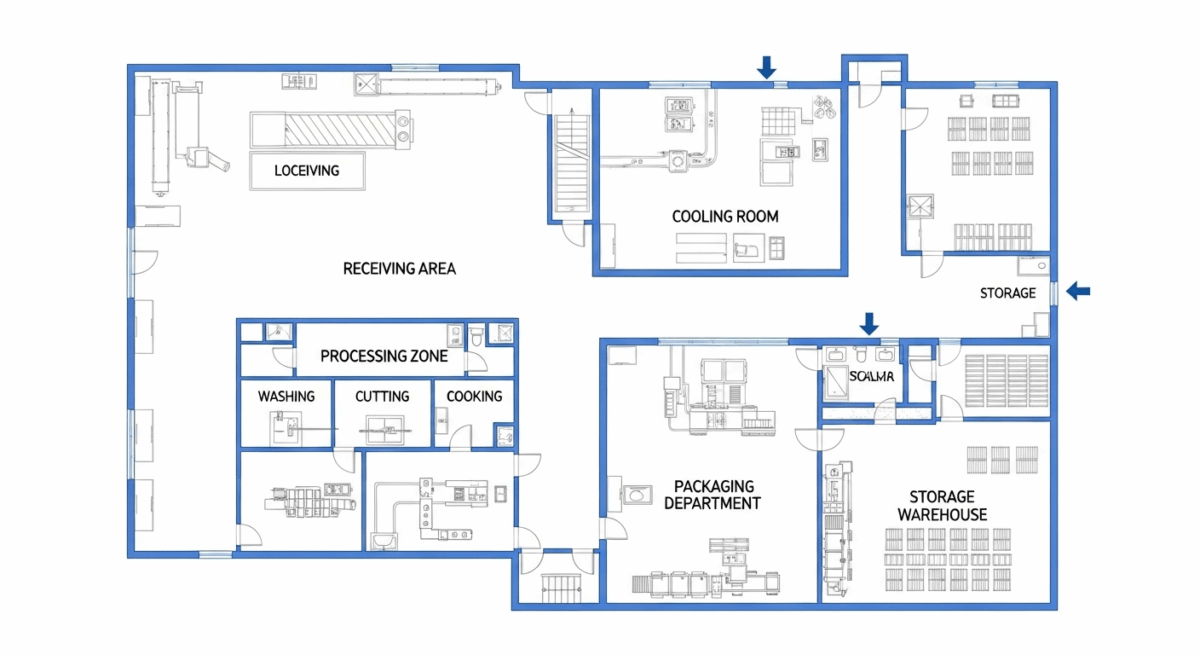
Deliverables: Detailed engineering drawings, equipment specifications, 3D visualizations, utility requirements
Your Role: Review and approve designs, provide feedback on workflow preferences
Pro Tip: Insist on 3D walkthroughs during turnkey food production line setup design. This helps identify potential workflow issues before expensive installation begins.
Phase 3: Equipment Procurement (6-12 Weeks)
The longest phase involves sourcing and manufacturing custom equipment:
Key Activities:
- Vendor selection: Choose certified equipment manufacturers meeting quality standards
- Custom fabrication: Many components require customization for your specific products
- Quality control: Factory acceptance testing (FAT) ensures equipment meets specifications
- Logistics coordination: Manage international shipping, customs, and delivery schedules
- Documentation: Collect operation manuals, certifications, and warranty information
Critical Equipment Categories:
Core Processing Equipment:
- Processing machines (cutting, mixing, grinding, cooking)
- Conveyor systems (belt type depends on product)
- Cooling and freezing equipment
- Packaging machinery
- Metal detectors and quality inspection systems
Support Infrastructure:
- Stainless steel work surfaces and tables
- Sanitation and CIP (Clean-In-Place) systems
- Waste management equipment
- Personnel hygiene stations
- Storage and material handling systems
Deliverables: Purchased equipment, shipping documentation, factory test reports
Your Role: Approve equipment selections, arrange payment schedules, prepare receiving area
Cost-Saving Tip: In turnkey food production line setup, balancing European quality with Turkish manufacturing can reduce equipment costs by 25-35% without compromising standards.
Phase 4: Installation & Integration (4-8 Weeks)
This is where your turnkey food production line setup comes to life:
Key Activities:
- Site preparation: Ensure foundations, utilities, and infrastructure are ready
- Equipment installation: Position and secure all machinery according to approved layouts
- Piping and electrical: Connect utilities, control systems, and safety equipment
- Mechanical integration: Link conveyor systems, transfer points, and processing stations
- Automation programming: Configure PLCs, sensors, and control systems
- Safety systems: Install emergency stops, alarms, and safety interlocks
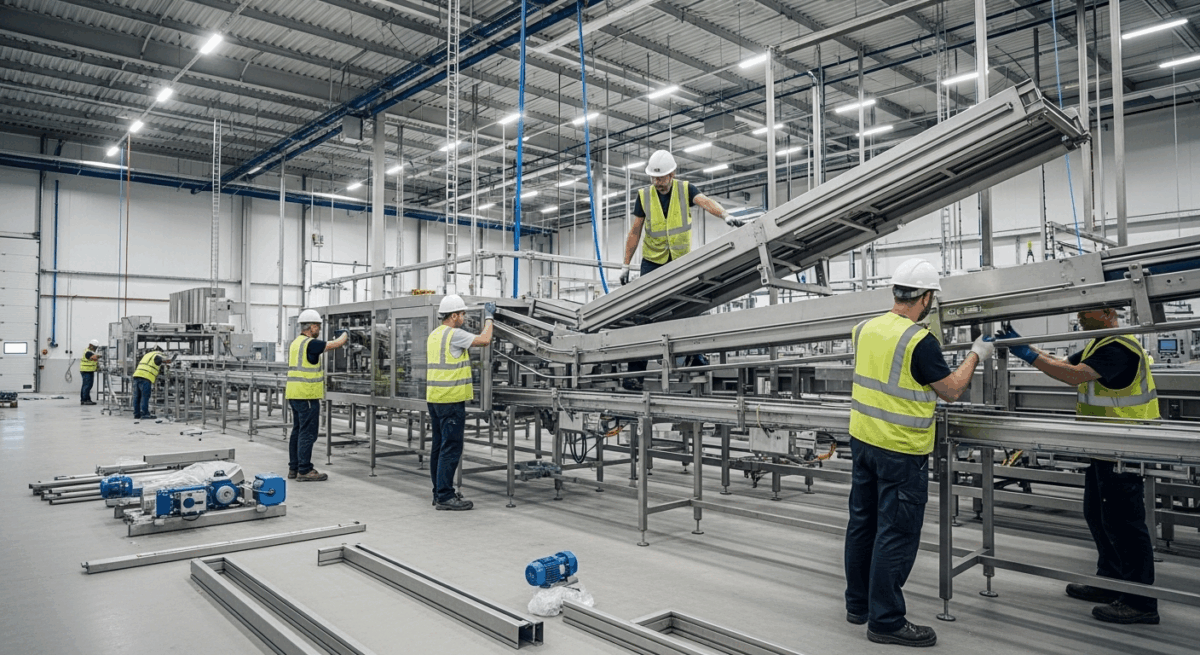
Deliverables: Fully installed production line, as-built drawings, system documentation
Your Role: Ensure site access, coordinate with local contractors, provide temporary utilities
Common Challenge: Delays often occur when site preparation isn’t complete before equipment arrival. In successful turnkey food production line setup projects, site readiness is verified two weeks before delivery.
Phase 5: Testing & Commissioning (2-4 Weeks)
Rigorous testing ensures your production line operates correctly:
Key Activities:
- Dry runs: Test mechanical systems without product
- Product trials: Run small batches to identify issues
- Capacity verification: Confirm line meets rated production targets
- Quality checks: Validate product consistency and specifications
- Safety testing: Verify all safety systems function correctly
- Calibration: Fine-tune speeds, temperatures, and timing
- Documentation: Record all parameters and standard operating procedures
Testing Checklist:
- ✅ Individual equipment function tests
- ✅ Integrated system operation
- ✅ Emergency shutdown procedures
- ✅ Cleaning and sanitization protocols
- ✅ Quality control point verification
- ✅ Production rate validation
- ✅ Energy consumption measurement
- ✅ Waste and byproduct handling
Deliverables: Commissioning report, operating parameters, validated SOPs
Your Role: Participate in testing, approve operational parameters, document any deficiencies
Success Metric: A properly executed turnkey food production line setup should achieve 85-90% of rated capacity within the first week of testing.
Phase 6: Training & Handover (1-2 Weeks)
The final phase ensures your team can operate and maintain the line independently:
Key Activities:
- Operator training: Teach production staff equipment operation and basic troubleshooting
- Maintenance training: Train technical team on preventive maintenance schedules
- Quality control training: Ensure QC staff understand inspection procedures
- Safety training: Comprehensive safety protocols and emergency procedures
- Documentation handover: Transfer all manuals, drawings, and certificates
- Spare parts provision: Stock critical replacement parts
- Performance guarantee period: Typically 30-90 days of supported operation
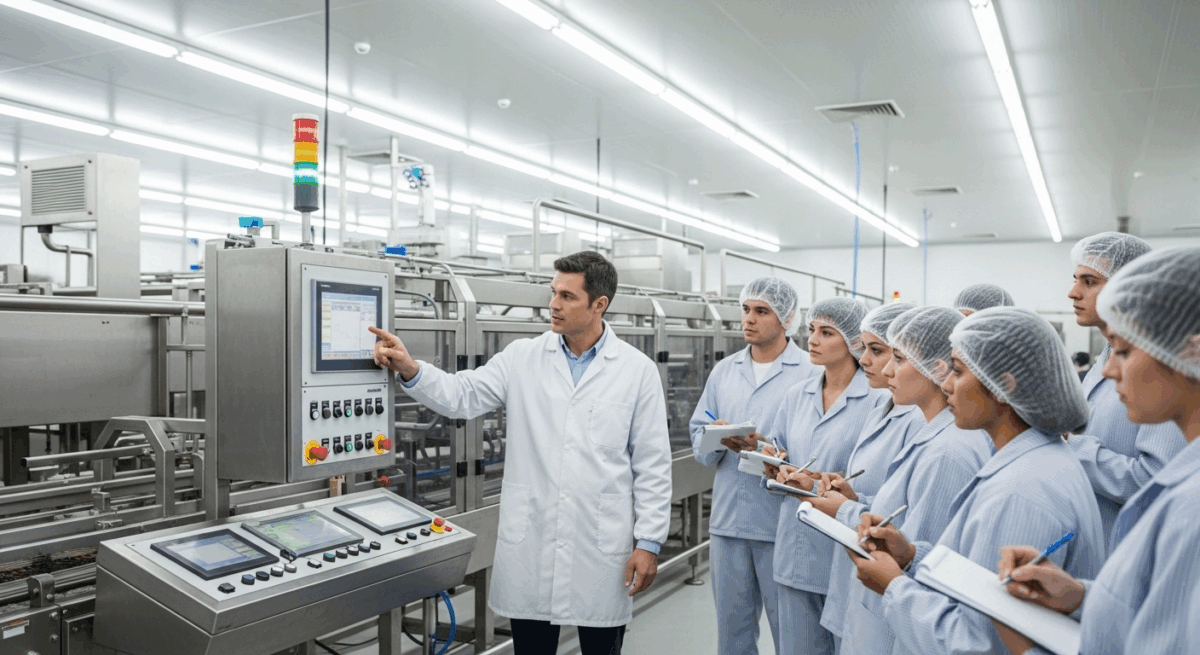
Training Topics:
- Equipment operation and control systems
- Start-up and shutdown procedures
- Cleaning and sanitization protocols
- Preventive maintenance schedules
- Common troubleshooting scenarios
- Quality control procedures
- Safety and emergency protocols
- Record keeping and documentation
Deliverables: Trained staff, operations manual, maintenance schedules, warranty documentation
Your Role: Ensure key staff participate fully, establish internal documentation systems
Long-term Success Factor: Companies that invest in comprehensive training during turnkey food production line setup experience 50% fewer operational issues in the first year.
Equipment Requirements by Food Type
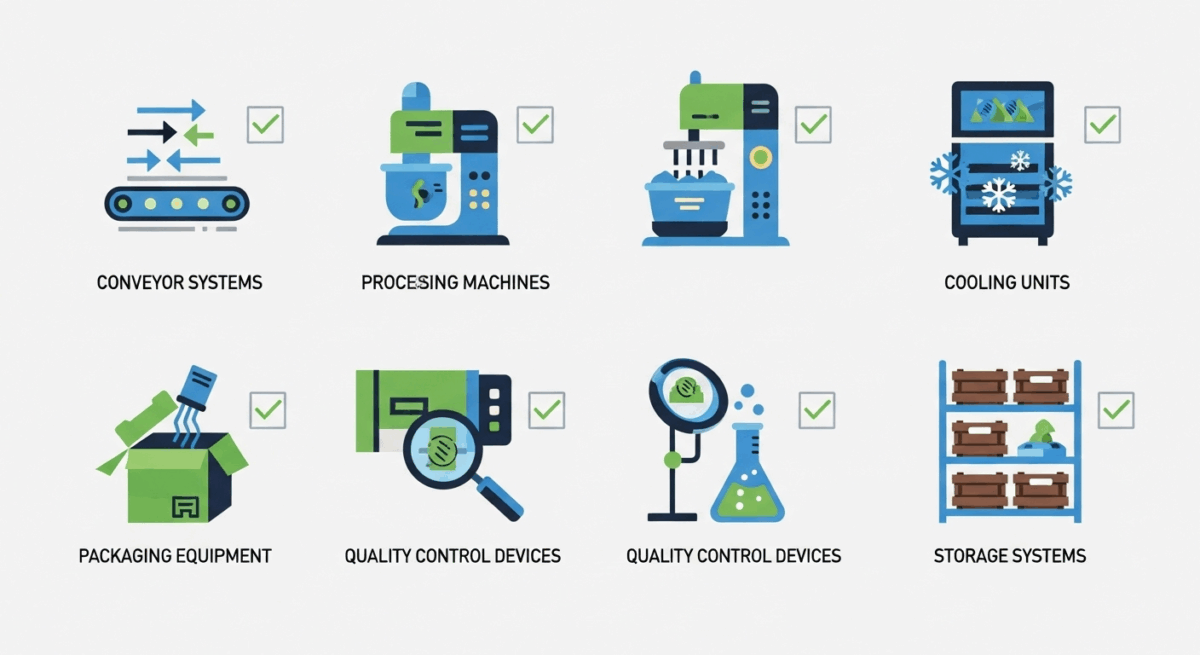
Different food products require specialized equipment. Here’s what you need for common production lines:
Poultry Processing Line
Essential Equipment:
- Stunning and bleeding systems
- Scalding and defeathering machines
- Evisceration equipment
- Chilling systems (air or water)
- Cut-up and deboning machines
- Grading and weighing systems
- Packaging equipment (tray sealers, vacuum packers)
Capacity Range: 500 – 15,000 birds/hour
Typical Investment: $250,000 – $2,500,000
Floor Space: 2,000 – 15,000 sq ft
Meat Processing Line
Essential Equipment:
- Meat grinders and mixers
- Forming and portioning machines
- Coating and breading systems (if applicable)
- Cooking equipment (ovens, fryers, smokers)
- Cooling and chilling tunnels
- Metal detection and X-ray inspection
- Vacuum packaging or MAP systems
Capacity Range: 500 – 5,000 kg/hour
Typical Investment: $300,000 – $3,000,000
Floor Space: 2,500 – 12,000 sq ft
Dairy Processing Line
Essential Equipment:
- Receiving and raw milk storage tanks
- Pasteurization systems (HTST or UHT)
- Homogenizers
- Separation and standardization equipment
- Fermentation tanks (for yogurt, cheese)
- Filling and packaging machines
- CIP (Clean-In-Place) systems
- Cold storage units
Capacity Range: 1,000 – 50,000 liters/day
Typical Investment: $400,000 – $4,000,000
Floor Space: 3,000 – 20,000 sq ft
Bakery Production Line
Essential Equipment:
- Industrial mixers (planetary, spiral, or horizontal)
- Dough dividers and rounders
- Proofing chambers
- Ovens (rack, tunnel, or rotary)
- Cooling conveyors
- Slicing equipment (for bread)
- Packaging machines (flow wrappers, baggers)
- Depositors (for cakes, pastries)
Capacity Range: 500 – 10,000 units/hour
Typical Investment: $200,000 – $2,000,000
Floor Space: 2,000 – 10,000 sq ft
Frozen Food Production Line
Essential Equipment:
- Preparation equipment (cutting, blanching)
- Quick freezing systems (IQF, spiral, blast)
- Metal detection systems
- Packaging equipment (vertical form-fill-seal, carton packers)
- Cold storage warehousing
- Blast freezer rooms
- Temperature monitoring systems
Capacity Range: 1,000 – 10,000 kg/hour
Typical Investment: $500,000 – $5,000,000
Floor Space: 4,000 – 25,000 sq ft
Cost Breakdown & Budget Planning
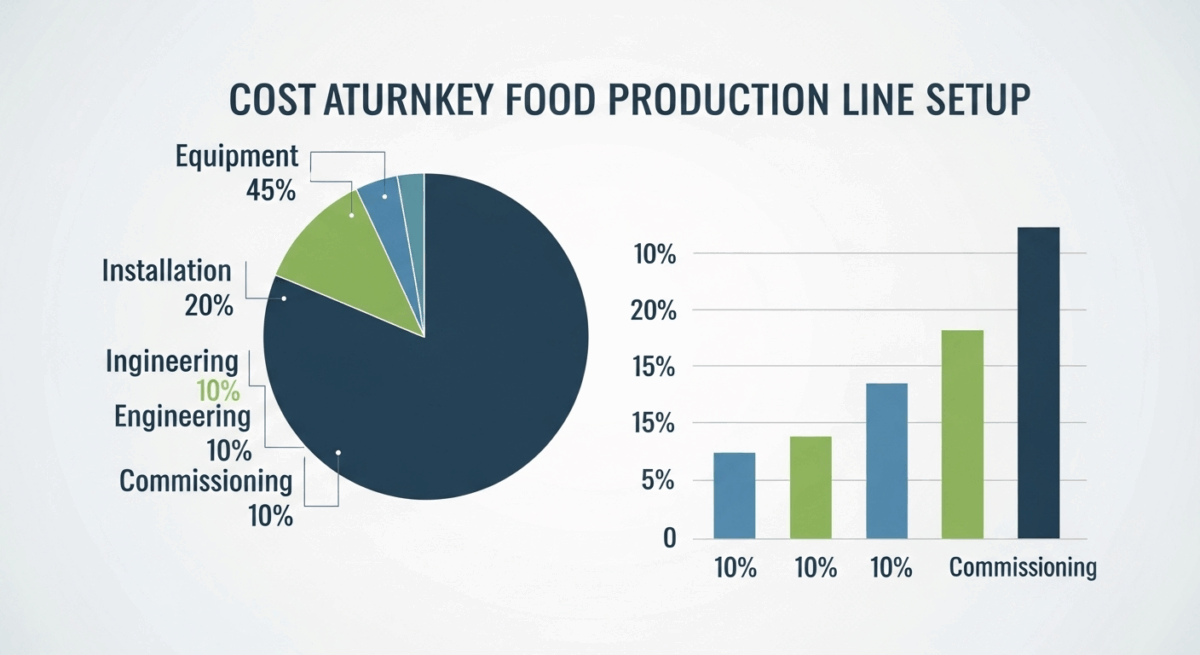
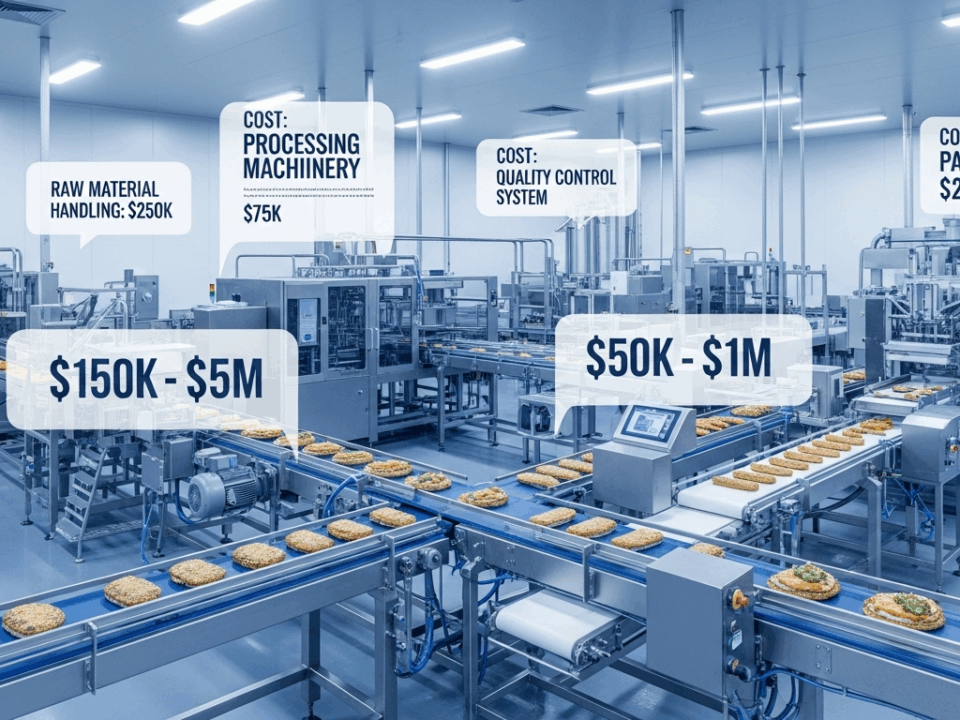
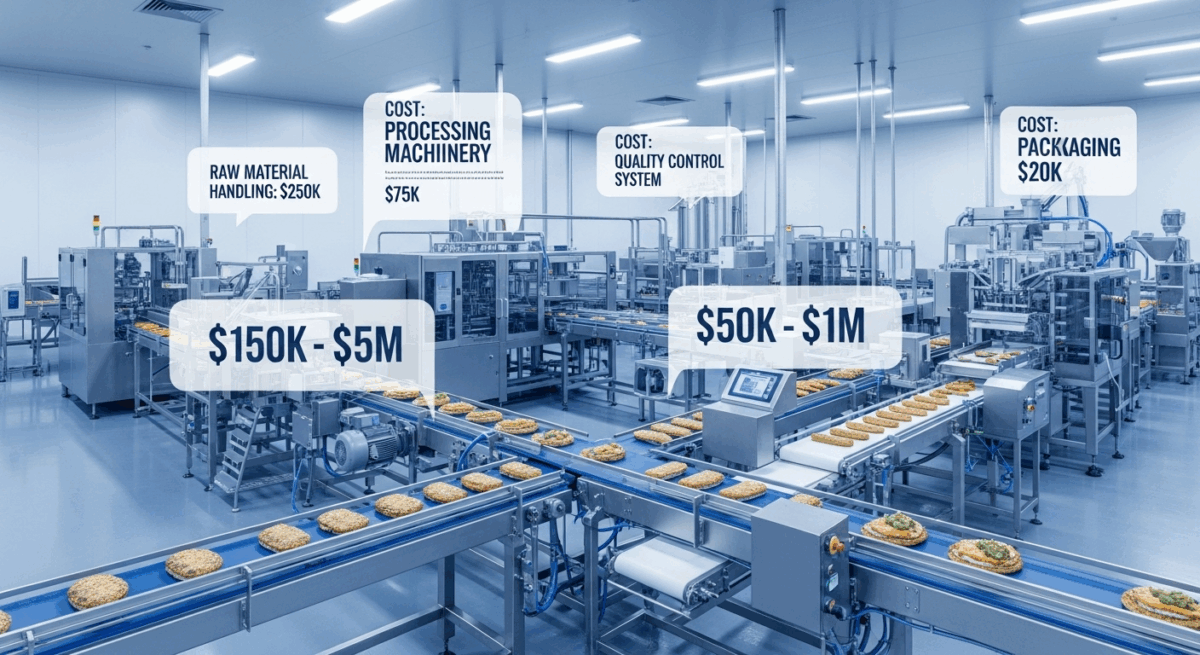
Understanding the complete financial picture of turnkey food production line setup helps you plan accurately:
Total Investment Categories
1. Equipment Costs (40-50% of total)
- Processing machinery: 35-40%
- Conveyor and material handling: 15-20%
- Packaging equipment: 15-20%
- Quality control systems: 5-10%
- Utilities and support equipment: 10-15%
Example for mid-scale meat processing:
- Core processing equipment: $400,000
- Conveyors and handling: $180,000
- Packaging line: $200,000
- Quality systems: $80,000
- Support equipment: $140,000
- Total Equipment: $1,000,000
2. Installation & Construction (20-25% of total)
- Civil works and foundations: 25-30%
- Mechanical installation: 30-35%
- Electrical and controls: 25-30%
- Piping and utilities: 15-20%
Typical Installation Costs:
- Small line (< $500K equipment): +30-35% of equipment cost
- Medium line ($500K-$2M equipment): +25-30% of equipment cost
- Large line (> $2M equipment): +20-25% of equipment cost
3. Engineering & Project Management (10-15% of total)
- Design and engineering: 40-50%
- Project management: 30-40%
- Permits and approvals: 10-15%
- Testing and commissioning: 10-15%
4. Training & Documentation (3-5% of total)
- On-site training programs
- Operations and maintenance manuals
- Video training materials
- Ongoing support during ramp-up
5. Contingency (5-10% of total)
Smart budgeting includes reserves for:
- Site condition surprises
- Specification changes
- Currency fluctuations (for imported equipment)
- Extended commissioning needs
Sample Budget: Complete Turnkey Food Production Line Setup
Project: 2,000 kg/hour poultry processing line
| Category | Amount | % of Total |
|---|---|---|
| Processing Equipment | $850,000 | 42% |
| Installation & Construction | $500,000 | 25% |
| Engineering & PM | $250,000 | 12% |
| Training & Documentation | $100,000 | 5% |
| Contingency | $150,000 | 7% |
| Working Capital (first 3 months) | $180,000 | 9% |
| Total Investment | $2,030,000 | 100% |
Expected ROI: 18-24 months at 70% capacity utilization
Financing Options for Turnkey Food Production Line Setup
- Bank Loans: 50-70% financing typical, 5-10 year terms
- Equipment Leasing: Lower upfront costs, 3-7 year terms
- Government Incentives: Many countries offer food manufacturing grants
- Vendor Financing: Some turnkey providers offer payment plans
- Private Equity: For larger projects with strong market potential
Timeline Expectations for Turnkey Food Production Line Setup
Understanding realistic timeframes prevents costly mistakes:
Small-Scale Production Line (< $500K)
- Feasibility & Design: 4-6 weeks
- Equipment Procurement: 8-12 weeks
- Installation & Commissioning: 4-6 weeks
- Total Timeline: 4-6 months
Best For: Startups, specialty products, regional distribution
Medium-Scale Production Line ($500K – $2M)
- Feasibility & Design: 6-10 weeks
- Equipment Procurement: 12-16 weeks
- Installation & Commissioning: 8-12 weeks
- Total Timeline: 6-9 months
Best For: Growing companies, national distribution, export markets
Large-Scale Production Line (> $2M)
- Feasibility & Design: 10-16 weeks
- Equipment Procurement: 16-24 weeks
- Installation & Commissioning: 12-16 weeks
- Total Timeline: 9-14 months
Best For: Established manufacturers, international operations, high-volume production
Timeline Acceleration Strategies
Want to speed up your turnkey food production line setup?
- Pre-approved designs: Use proven templates requiring minimal customization
- Modular systems: Pre-fabricated units reduce on-site installation time
- Parallel activities: Overlap procurement with site preparation
- Off-site testing: FAT (Factory Acceptance Testing) before delivery
- Experienced contractors: Premium installers work 30-40% faster
Reality Check: Rushing critical phases of turnkey food production line setup often creates expensive problems. A realistic timeline with proper planning beats an aggressive schedule with costly fixes.
10 Common Mistakes in Turnkey Food Production Line Setup
Learn from others’ expensive errors:
1. Underestimating Capacity Requirements
The Mistake: Planning for current demand without growth buffer
The Cost: Costly expansion or complete line replacement within 2-3 years
The Solution: Design for 150-200% of current volume from day one
2. Ignoring Product Variations
The Mistake: Optimizing line for one product only
The Cost: Cannot accommodate product line extensions or seasonal variations
The Solution: Build flexibility into turnkey food production line setup for 3-5 product variations
3. Skimping on Quality Control Equipment
The Mistake: Treating inspection systems as optional extras
The Cost: Product recalls, brand damage, regulatory fines
The Solution: Budget 8-12% of equipment costs for quality systems (metal detectors, checkweighers, vision systems)
4. Poor Utility Planning
The Mistake: Underestimating power, water, or compressed air needs
The Cost: Production bottlenecks, expensive mid-project utility upgrades
The Solution: Add 20-30% utility capacity buffer in turnkey food production line setup design
5. Inadequate Cleaning Design
The Mistake: Equipment difficult to clean or no CIP systems
The Cost: Excessive downtime, contamination risks, labor costs
The Solution: Specify sanitary design and automated cleaning from the start
6. Choosing Equipment Based Only on Price
The Mistake: Selecting cheapest option without evaluating reliability
The Cost: Frequent breakdowns, expensive repairs, lost production
The Solution: Evaluate total cost of ownership (TCO) over 5-10 years, not just purchase price
7. Insufficient Staff Training
The Mistake: Minimal training to “save time”
The Cost: Equipment damage, safety incidents, poor efficiency
The Solution: Invest in comprehensive training during turnkey food production line setup (minimum 2 weeks for operators, 1 week for maintenance)
8. No Spare Parts Strategy
The Mistake: Starting production without critical spare parts inventory
The Cost: Days or weeks of downtime waiting for replacement parts
The Solution: Stock 3-6 months of critical wear parts before production starts
9. Ignoring Energy Efficiency
The Mistake: Focusing only on upfront equipment costs
The Cost: 30-50% higher operational costs over equipment lifetime
The Solution: Specify energy-efficient equipment in turnkey food production line setup; 15-20% premium often pays back in 2-3 years
10. Inadequate Documentation
The Mistake: Accepting incomplete manuals and missing drawings
The Cost: Difficult troubleshooting, training challenges, compliance issues
The Solution: Require comprehensive documentation as contractual deliverable: operation manuals, maintenance procedures, electrical schematics, PLC programs, spare parts lists
Real-World Case Study: Successful Turnkey Food Production Line Setup
Client: Mid-size poultry processor expanding to meet export demand
Challenge:
- Manual processing limiting capacity to 800 birds/hour
- Inconsistent product quality affecting export certification
- High labor costs and safety concerns
- Needed to scale to 3,000 birds/hour for contract fulfillment
Solution: Complete Turnkey Food Production Line Setup
Phase 1: Assessment (3 weeks)
- Evaluated existing facility and determined expansion feasibility
- Calculated optimal capacity for target markets
- Developed 5-year production forecast
Phase 2: Design (6 weeks)
- Created integrated line for stunning through packaging
- Designed HACCP-compliant workflow
- Specified automated systems to reduce labor by 60%
Phase 3: Implementation (20 weeks)
- Installed fully automated poultry processing line
- Integrated quality control and traceability systems
- Trained 45 staff members on new equipment
Investment Breakdown:
- Equipment: $1,200,000
- Installation: $400,000
- Engineering: $180,000
- Training: $70,000
- Contingency: $150,000
- Total: $2,000,000
Results After 12 Months:
- ✅ Production capacity increased 275% (800 → 3,000 birds/hour)
- ✅ Product consistency improved (rejection rate dropped from 12% to 2%)
- ✅ Labor costs reduced 58% per unit produced
- ✅ Export certification achieved for EU and Middle East markets
- ✅ ROI timeline: 22 months (faster than projected 30 months)
- ✅ New revenue: $4.2M annually from export contracts
Client Testimonial: “The turnkey food production line setup transformed our business. Instead of managing five different contractors, we had one expert partner handling everything. We went from concept to full production in seven months—and the line exceeded performance guarantees from day one.”
Your Getting Started Checklist
Ready to begin your turnkey food production line setup? Use this checklist:
Before Contacting Suppliers:
- [ ] Define your product specifications (type, format, packaging)
- [ ] Determine target production capacity (units/hour or kg/hour)
- [ ] Identify target markets (domestic, export, regions)
- [ ] Establish preliminary budget range
- [ ] Secure or identify suitable facility location
- [ ] Understand basic regulatory requirements for your product
- [ ] Develop 3-5 year business projections
When Evaluating Turnkey Providers:
- [ ] Review portfolio of similar turnkey food production line setup projects
- [ ] Request client references (minimum 3, preferably in your industry)
- [ ] Verify engineering certifications and qualifications
- [ ] Understand warranty terms and after-sales support
- [ ] Clarify project timeline and payment schedule
- [ ] Review sample contract terms before commitment
- [ ] Assess financial stability of provider (especially for long projects)
During Project Execution:
- [ ] Attend all design review meetings
- [ ] Conduct factory acceptance tests before equipment shipment
- [ ] Prepare site per approved specifications
- [ ] Participate in commissioning and testing
- [ ] Document all operational parameters
- [ ] Complete all training programs
- [ ] Establish spare parts inventory
- [ ] Set up preventive maintenance schedules
Frequently Asked Questions
How long does a typical turnkey food production line setup take?
Small lines (< $500K): 4-6 months
Medium lines ($500K-$2M): 6-9 months
Large lines (> $2M): 9-14 months
Timeline depends on equipment customization, site readiness, and regulatory approvals.
What’s the difference between turnkey and traditional project delivery?
In traditional delivery, you coordinate separate contracts for design, equipment, installation, and commissioning. Turnkey food production line setup consolidates everything under one provider, one contract, and one point of responsibility—reducing risk and simplifying management.
How much should I budget for a complete production line?
Small-scale: $200K-$500K
Medium-scale: $500K-$2M
Large-scale: $2M-$10M+
Budget 45-50% for equipment, 20-25% for installation, 10-15% for engineering, and 10-15% contingency.
Can I phase the implementation?
Yes, modular turnkey food production line setup allows you to start with core equipment and add capacity or functionality later. However, planning the complete vision from day one prevents costly retrofits.
What happens if equipment doesn’t meet specifications?
Reputable turnkey providers offer performance guarantees. If equipment fails to meet contracted capacity or quality specs during commissioning, they must modify or replace at no cost to you.
Do I need to hire an independent consultant?
For investments above $1M, many companies hire independent consultants to review designs and oversee installation. This adds 2-3% to project costs but provides valuable third-party validation.
How do I ensure the line can accommodate future products?
During turnkey food production line setup design, specify flexibility requirements: adjustable speeds, changeable tooling, modular components, and upgrade paths. This adds 10-15% to initial costs but protects future expansion.
What certifications should the equipment have?
Essential certifications for food production equipment:
- CE marking (for European-sourced equipment)
- NSF or 3-A Sanitary Standards
- USDA or FDA compliance (if exporting to US)
- ISO 22000 or FSSC 22000 compatibility
- Electrical safety certifications for your country
Conclusion: Your Path to Production Success
A well-executed turnkey food production line setup is more than buying equipment—it’s a strategic investment in your business’s future. By following the proven six-phase process outlined in this guide, you’ll avoid the costly mistakes that plague rushed or poorly planned projects.
Key Takeaways:
- Start with thorough planning: Invest time in feasibility studies and capacity planning before committing to equipment
- Choose the right partner: An experienced turnkey provider is worth premium pricing for the risk reduction alone
- Don’t compromise on quality systems: The 8-12% invested in quality control equipment protects your brand and prevents recalls
- Plan for growth: Design for 150-200% of current volume to avoid expensive expansion within 2-3 years
- Invest in training: Comprehensive operator and maintenance training during turnkey food production line setup pays dividends for years
Whether you’re starting a new food manufacturing business or modernizing an existing facility, the turnkey approach offers the fastest, lowest-risk path from concept to profitable production.
Ready to Start Your Turnkey Food Production Line Setup?
Our experienced team has successfully delivered 45+ complete production lines across 11 countries, from small specialty processors to large-scale export facilities.
Get Your Free Consultation:
- ✅ Capacity analysis and recommendations
- ✅ Preliminary budget estimate
- ✅ Project timeline projection
- ✅ Equipment specifications review
- ✅ Financing options overview
Contact us today to discuss your turnkey food production line setup requirements. Our project engineers respond within 24 hours with initial assessments.